


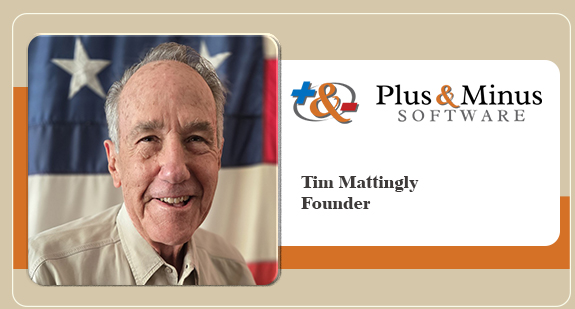
Inside Plus & Minus: A Conversation with Its Founding Minds
ERP systems don’t usually get simpler over time. As companies grow, their accounting software tends to follow the same path: more modules, more integrations, and more time spent making everything line up.
Plus & Minus took a different route early on. Instead of building programs, the company focused on keeping the data together. Decades later, that decision still defines how the system works.
Let’s start at the beginning. What led to the creation of Plus & Minus?
The idea goes back to 1973, when Tim Mattingly and Tom Friedman began working on accounting systems for major energy companies.
At that time, the thinking was already clear. Instead of adding modules, the goal was to simplify how the accounting data was stored and retrieved. By 1982, that thinking turned into Plus & Minus as a system.
“Accounting software should make your life easier, not more complicated.”
That belief hasn’t really changed. Even as the technology evolved, the focus stayed on reducing effort rather than adding more processes.

Your system is often described as a “single-file, non-modular ERP.” What does that mean?
It means all data sits in one database.
Instead of splitting functions such as general ledger, accounts payable, accounts receivable, payroll, inventory, fixed assets, inter-company, and foreign currency into separate modules, everything is kept together in a single structure.
Every journal entry, vendor payment, customer invoice, and paycheck follows the same format and goes into the same place.
“You’re not moving between modules. You’re working inside one.”
That removes the usual steps people expect:
- No batching
- No posting
- No waiting for updates between systems
It’s all there, in real time.
How does that change the way people use the system day to day?
The biggest difference is the consistency of data.
When you run a report, you’re not pulling information from different modules and trying to reconcile them. Everything comes from the same dataset.
“There’s no second version of the numbers.”
That makes reporting faster, but more importantly, it makes it reliable. You’re not double-checking whether different parts of the system agree with each other; they already do.
What kinds of challenges are companies dealing with before they switch accounting software providers?
The problems usually build over time.
Many companies outgrow their existing software. They start noticing slow performance or limitations, and then there’s the upsell to move into versions they don’t really want.
Others are working with outdated or unsupported systems.
And then there’s the day-to-day side:
- Spreadsheets fill in the gaps to complete management reports
- Time-consuming manual processes
- Dependence on outside accountants
- Delays in getting critical reports
“It’s not one major issue, it’s a lot of small inefficiencies adding up.”
Integration of modules also becomes a problem. When accounting modules don’t connect well with POS, payroll, or project tools, it leads to duplicate work and disconnected data.
Where do clients see the biggest impact after moving to Plus & Minus?
Time savings stand out right away.
Reconciliation is one of the biggest time drains in traditional systems. Clients typically save 15 to 20 hours per month because there’s nothing to reconcile.
“When everything is already aligned, that step just disappears.”
Cost is the other major factor.
The pricing is simple:
- $1,000 setup
- $1,000 per month for 1–10 users
- $1,000 per month for each additional 10 users
- No module fees
- No payroll or bank reconciliation charges
That structure is why many clients see 20% to 90% cost savings compared to modular ERP systems.
Implementation is also faster. With clean Excel data, companies can be up and running in 8 to 12 hours, instead of spending months on setup.
How do you approach growth in such a competitive ERP market?
We keep it focused.
About 20% of revenue goes into marketing, mainly through platforms like Gartner, Forrester, and Deloitte.
Those are places where companies are already looking for new accounting solutions.
We’ve also introduced PAM, an AI Accounting Software Assistant.
“If PAM doesn’t know the answer, the question gets escalated and then added back into the system.”
So over time, PAM becomes more useful with every interaction.
How is Plus & Minus adapting to AI, automation, and cloud technology?
We’ve focused on practical use rather than just adding features.
Our “Presets” feature is a good example. It lets users save report settings, so they don’t have to configure them repeatedly. Each user can create up to 1,000 presets per function.
“You don’t have to rebuild the same report every time.”
On the technology side, the system is built using C# with Blazor and uses PostgreSQL for data storage.
It runs across Windows, macOS, and Linux without needing special setups.
Performance is strong enough that users rarely purge data—several customers have been running the same database for over 20 years.
We also provide a REST API and integrate with Plaid for bank transactions.
In 2024, we started demonstrating AI through the “Show me the money!” routine. Since everything is stored in one database, AI queries don’t have to navigate multiple systems—the system generates a full report instantly on request.
What role does leadership play in shaping how the company operates today?
It comes back to the original approach taken by Tim Mattingly and Tom Friedman—always keeping things straightforward and practical.
That carries into how we support customers.
Our support team is made up of U.S. university accounting graduates working under CPAs. Each person is responsible for around 200 customers, which allows for consistent interaction.
On average, each customer receives about 45 minutes of support per month.
And if they don’t reach out?
“If our customers don’t call us once a month, we call them.”
There’s also a slightly different perspective on accounting itself. While CPA firms often focus on minimizing taxes, our focus is on helping businesses maximize revenue and profitability.
After all these years, what has stayed consistent?
A consistent, unchanging Design Discipline—a repeatable framework that guides every decision regardless of the accounting function. What changes is the content; what never changes are the structure, the rigor, and the workflows.
“Keep everything in one place, and make it work properly.”
That’s really what defines the system.
Instead of adding complexity, the focus has always been on removing it. And for many businesses, that ends up making the biggest difference not just in how the system works, but in how much time and effort it saves every day.


Company Name : Plus & Minus Software
Website : https://plusandminus.com/
Management Team
Tim Mattingly | Founder

