


When the Numbers Aren’t Enough: The Rise of Stewardship Leadership
Technology and business have a way of making us focus on what can be measured.
Revenue. Valuation. Market share. Assets. Users. Growth.
After years working across finance and technology, becoming an entrepreneur, and conducting more than 600 conversations with founders, leaders, and executives, I have become increasingly interested in what those measurements leave out.
What happens when an organization reaches a moment when the direction forward isn’t obvious?
What should change? What should remain? Where has trust been accumulated or depleted? What has experience taught us? And amid competing priorities, what matters enough to defend?
Those questions eventually led me to develop STEWARD, a proprietary framework and methodology for Stewardship Conversations with boards and leadership teams wrestling with consequential decisions about the future of their organizations.
But the thinking behind it began years earlier.
From Governance Critic to Steward
When I left AIG in 2017, I could have attempted to move directly into another executive role. Instead, I became an entrepreneur and began writing publicly about systems I believed deserved greater scrutiny.
That included Re-Generation X, in which I challenged aspects of the post-Dodd-Frank corporate governance environment and questioned whether some mechanisms intended to improve accountability were necessarily producing the outcomes their architects envisioned.
At that stage, I was largely looking at governance from the outside in.
Nearly a decade later, my perspective has evolved.
Entrepreneurship changed it. Building my own platforms changed it. Publishing extensively changed it. Most importantly, hundreds of conversations with people responsible for building and leading organizations gave me a different window into governance.
I heard what happens when conviction meets uncertainty. Founders discussed growth, failure, changing markets, technology, succession, competing stakeholders, and decisions whose consequences ultimately belonged to them.
My thinking gradually moved from critiquing governance structures to understanding the people responsible for stewarding them.
Governance can establish rules, oversight, accountability, and responsibilities. But eventually human beings sitting around a table still have to decide what they believe should happen next.
That accumulated experience became the foundation for STEWARD.
The Framework Is Not the Methodology
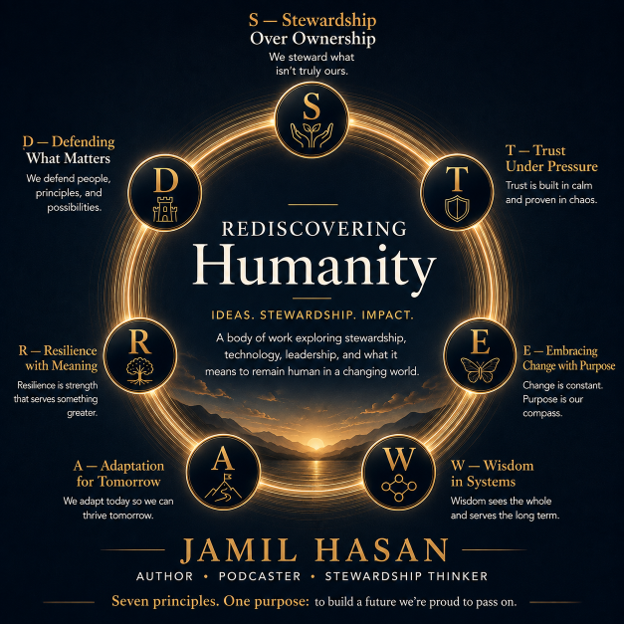
STEWARD stands for:
S — Stewardship Over Ownership
T — Trust Under Pressure
E — Embracing Change with Purpose
W — Wisdom in Systems
A — Adaptation for Tomorrow
R — Resilience with Meaning
D — Defending What Matters
Behind the acronym sits years of intellectual property developed through corporate experience, entrepreneurship, publishing, and hundreds of direct conversations with people responsible for organizations and their consequences.
I use that proprietary methodology in Stewardship Conversations with boards and leadership teams confronting moments when conventional analysis alone may not resolve the issue in front of them.
STEWARD is intentionally independent of industry.
A technology company confronting artificial intelligence may appear to have little in common with a family enterprise approaching succession, an established company reconsidering its identity, or a board navigating restructuring. Yet beneath those situations are often similar questions about responsibility, trust, change, institutional wisdom, adaptation, resilience, and what must ultimately be protected.
My role isn’t to enter the room and tell experienced leaders how to run their organization. They understand their company, stakeholders, and history better than I do.
My role is to steward the conversation.
The framework is consistent. The conversation is adaptive. The outcome belongs to the organization.
That matters because the presenting problem and the underlying problem aren’t always the same.
A discussion about technology may actually be about identity. Growth can expose questions about culture. Succession may become a debate about institutional memory. Restructuring can test relationships that took decades to establish.
Sometimes the numbers accurately describe the problem without capturing everything that is at stake.
The Emotional Balance Sheet
That brings me to another concept I have been developing: Emotional Assets.
Institutional memory, resilience, reputation, purpose, and accumulated human experience all possess value.
They can also be depleted.
A company can increase financial value while destroying trust. A leadership team can improve efficiency while weakening relationships. An organization can implement transformative technology while unintentionally eroding something fundamental about its identity.
Accounting may never record those losses.
People do.
Emotional Assets doesn’t mean abandoning conventional measures. It means recognizing that consequential leadership decisions operate across more than one balance sheet.
When a board considers transformation, succession, technology, growth, or restructuring, the financial questions matter. But leadership should also consider what the organization is strengthening, what it is spending, what it is risking, and what may be extraordinarily difficult to rebuild once it is gone.
From Crypto Hipster to a Broader Conversation
I founded the Crypto Hipster podcast in 2021 and Crypto Hipster Publications in 2022. In 2026, I relaunched the podcast around founder journeys rather than product promotion.
That work originated in the digital economy, but the lessons did not stay there.
After hundreds of founder conversations, I became less interested in predicting which technology would win and more interested in how people behave while building, inheriting, changing, and defending systems.
Technology will continue changing. Artificial intelligence is accelerating that change today; something else inevitably will tomorrow.
The leadership challenge is larger.
As systems become more capable, leaders must determine where judgment remains essential. As information becomes easier to produce, credibility becomes more valuable. As organizations become more efficient, relationships and trust become greater sources of differentiation.
These are not crypto questions.
They are stewardship questions.
When the Numbers Aren’t Enough
My perspective on governance today is different from the one I had when I first began writing about it.
That evolution is important.
Years of entrepreneurship and hundreds of conversations didn’t give me a collection of universal answers. They gave me something I believe is more useful: patterns, questions, perspectives, and a methodology for helping leadership teams examine what conventional analysis may overlook.
STEWARD grew from that accumulated intellectual property.
Every leadership team will eventually encounter a decision for which spreadsheets, forecasts, governance structures, and strategic models are necessary—but insufficient.
STEWARD was built for those moments: when leadership knows a decision must be made, but the numbers alone cannot tell them what the right decision is.


Company Name : Crypto Hipster Publications LLC
Website : https://cryptohipster.tech/
Management Team
Jamil Hasan | Founder

