


Medical education has never been short of information. The challenge has always been knowing what to do with it.
Students move between lecture slides, question banks, flashcards, reference materials and simulation tools, often using several platforms simply to prepare for one course or examination. Dendritic Health AI was created around a straightforward observation: the technology supporting medical education has not kept pace with the way students learn.
The U.S.-based company is taking a different approach through Neural Consult, its flagship AI-native healthcare education platform. Rather than adding another disconnected application to the existing mix, Dendritic Health is working toward an environment where learning resources, curriculum, assessment and practice can work together.
That ambition is also reflected on the company’s website, where Dendritic Health describes its focus as using AI to provide personalized learning experiences, strengthen knowledge retention and prepare the next generation of healthcare professionals.
Bringing the Pieces Together
The name Dendritic Health comes from the dendrite, the part of a neuron that receives and integrates signals from multiple sources. It is an apt description of what the company is trying to accomplish.
The idea is to take what an institution teaches and what a student does with that material, then connect the two in a more intelligent learning environment.
Neural Consult brings together practice questions, flashcards, study summaries, clinical simulations and reference materials. Each partnered institution can have its own, white-labeled environment, integrated around its curriculum. Importantly, the company’s approach is to ground AI-generated material in the institution’s own source content rather than relying simply on generic information from the open internet.
For students, this can make preparation more closely aligned with what they are expected to know. For faculty, it provides greater visibility into performance and engagement, while retaining administrative oversight of AI-generated content.
The company’s website similarly highlights personalized learning paths, intelligent assessment, simulated patient interactions and collaborative learning as important parts of its platform.
From Studying to Practicing
One of the more interesting aspects of Neural Consult is that it does not treat AI simply as a faster way to produce study notes.
Its AI tutor, Glia, is designed to provide students with an always-available guide for questions and study strategy. At the same time, the platform can transform existing educational material such as lecture slides and course notes into practice questions, flashcards, summaries and podcasts.
That distinction matters. The goal is not merely to give students more content. It is to reduce the amount of time they spend preparing materials so they can spend more time actively learning.
Clinical practice is another important part of the picture. Neural Consult’s Clinical Case Simulator allows students to interact with AI patients in realistic OSCE-style scenarios. Faculty can review and edit cases before they reach learners, creating an environment where students can repeatedly practice clinical reasoning and communication before facing higher-stakes encounters.
Dendritic Health’s website places similar emphasis on simulation, describing tools designed to replicate real patient interactions and help students prepare for patient care.
Personalization That Goes Beyond a Buzzword
Personalized learning is often discussed in broad terms, but Dendritic Health is looking to connect personalization with actual student performance.
Learning plans can use assessment and performance data to identify where an individual student needs to focus next. The longer-term objective is to ingest data from platforms institutions already use, allowing recommendations to reflect real performance rather than assumptions about how a student learns.
This also creates an opportunity for educators. Learning analytics can provide signals about where students are struggling before those difficulties become obvious in examination results.
That thinking is visible in Dendritic Health’s own recent focus on study-session data and learner engagement. The company’s website discusses how patterns in study activity can provide earlier indications of difficulty, while flashcard engagement can reveal areas where learners need repeated reinforcement.
Where Medical Education Goes Next
For Dendritic Health, the next stage of medical education will be shaped by several technologies working together.
Retrieval-grounded AI is one. Generic chatbots may be impressive, but healthcare institutions need systems capable of answering from their own curriculum, cases and standards. That makes trustworthy source grounding increasingly important.
Multimodal simulation is another. Voice-driven AI patients and increasingly realistic virtual encounters could give students more opportunities to practice communication and clinical reasoning at scale.
Assessment data will also become more valuable. As educational platforms become better connected, student performance can move from being something reviewed after an examination to something that actively shapes the next learning experience.
Alongside these developments, governance will become increasingly important. Dendritic Health recognizes that institutions need confidence around privacy, security, accessibility and responsible AI adoption. The company is currently working through its SOC 2 Type II audit and has adopted WCAG 2.2 AA as its accessibility standard.
A Leadership Team Built Around the Problem
Building that kind of learning environment requires more than technical expertise alone. The people behind Neural Consult bring an unusual combination of clinical and technical experience.
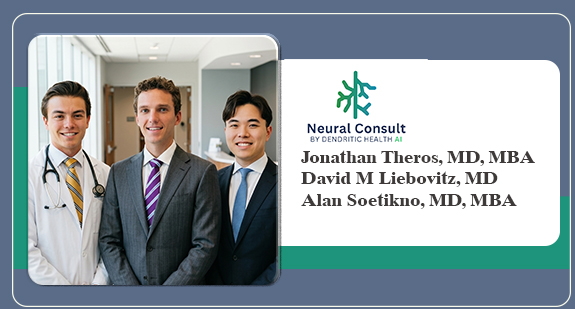
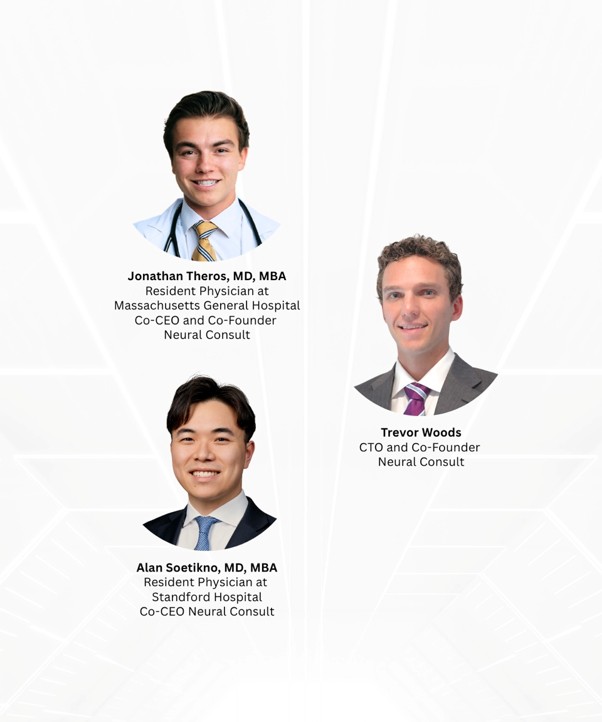
Co-CEO Jonathan Theros, MD, MBA, is a resident physician at Massachusetts General Hospital and brings direct experience with medical training, including scoring in the 100th percentile on USMLE Step 2. His experience building companies also predates Neural Consult: while still in college, Theros built and successfully exited an earlier venture, giving him firsthand experience taking a project from concept through growth and exit.
His fellow Co-CEO, Alan Soetikno, MD, MBA, combines medicine with a background in data science. A former Amazon data scientist who later moved into medicine, Soetikno is now a resident physician at Stanford Medicine and has led much of the AI development behind Neural Consult. His experience on both sides of that divide gives him a distinctive perspective on how technology can be designed around the realities of healthcare education and clinical training.
CTO Trevor Woods brings the engineering counterpart to that clinical expertise. Before joining Neural Consult, Woods spent four years as a software engineer with Infosys’ Strategic Technology Group, working across back-end systems and cloud infrastructure. His background also includes software engineering and user experience work at the University of Michigan. At Neural Consult, he oversees the technical architecture and engineering infrastructure required to turn the company’s AI concepts into a platform capable of operating at institutional scale.
Together, the executive team represents the intersection Dendritic Health believes is necessary for the future of healthcare education: physicians who understand the realities of medical training, experienced technologists capable of turning those insights into scalable products, and leadership with prior experience building and growing new ventures.
That perspective has influenced the company’s approach from the start. Rather than developing AI in isolation and asking institutions to adapt around it, Dendritic Health builds alongside educators and institutions, keeping faculty judgement central to the process.
Building Trust One Institution at a Time
The company’s immediate priorities reflect that philosophy. Dendritic Health is focused on expanding institutional deployments, moving faculty-authored cases into newer generations of its OSCE simulator, strengthening faculty analytics and improving personalization through assessment data.
Longer term, the opportunity extends beyond medical schools to the broader healthcare education landscape. The underlying problem fragmented learning tools disconnected from institutional curricula is not limited to one profession.
For Dendritic Health, growth is not simply about adding more users or features. It is about proving that AI can become a useful part of the educational infrastructure itself.
The company’s mission is ultimately grounded in a practical idea: better technology should help people learn better, not simply give them more technology to manage.
As healthcare education becomes increasingly digital, that distinction could prove important. Dendritic Health is betting that the future will belong not to isolated AI tools, but to connected learning environments that understand the curriculum, respond to the learner and keep educators firmly in the loop.
“The goal isn’t to give students another tool. It’s to make the tools they already use work together.”
- Alan Soetikno, MD, MBA and Co-CEO of Neural Consult
“AI can generate the material, but it takes an educator’s judgment to make it trustworthy.”

Company Name : Neural Consult
Website : https://neuralconsult.com/
Management Team
Jonathan Theros | Co-CEO and Co-Founder
Alan Soetikno | Co-CEO
Trevor Woods | CTO and Co-Founder

