


Happy Life Academy: A Conversation on Education, Inner Structure, and Leadership
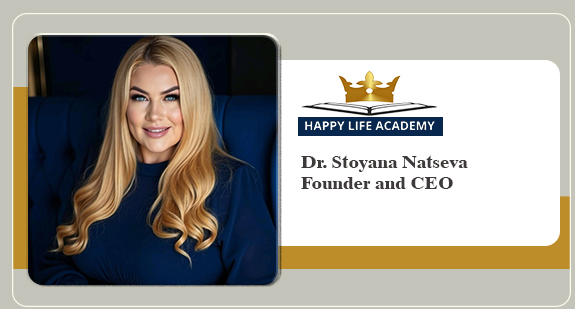
In an education market crowded with courses and certifications, Happy Life Academy has followed a quieter, more structured path. In this conversation, Dr. Stoyana Natseva Founder & CEO reflects on how academic research, psychology, and leadership education came together and why inner structure remains at the centre of the Academy’s work.
Happy Life Academy began as a very personal idea and has now reached more than 100,000 students globally. When you look back, what made you realize people were searching for something different from traditional personal development?
From the beginning, my academic background made something very clear to me. People were not lacking information. They were lacking inner structure. As a Professor and Doctor of Psychology, and through my research on the Internal Autobiographical Map, I saw the same pattern repeatedly. People would change methods, environments, even careers, yet their lives kept repeating similar outcomes.
Traditional personal development often focuses on visible symptoms, “motivation, habits, or mindset” without addressing why those patterns exist in the first place. My research showed that identity, emotional memory, and internal narratives shape decisions over time. That insight later became the foundation of my scientific monographs. Happy Life Academy was created to address that gap, not as motivational entertainment, but as a serious educational system.
Your work brings together psychology, science, and coaching, which is still uncommon in many education models. Why do you think this combination resonates so strongly with professionals?
Because it reflects how people function. Sustainable change does not happen through theory alone, and coaching without structure often remains superficial. Psychology helps explain how cognitive and emotional patterns are formed. Education provides structure and language. Coaching supports application in real life.
When these elements are integrated, people begin to understand themselves as systems rather than problems to fix. This approach resonates with individuals who are ready to move beyond slogans and quick solutions. They want clarity, structure, and responsibility, especially in leadership and career contexts.

Many graduates describe their experience at the Academy as a turning point. Without getting too technical, what changes during the programs?
The change happens when people understand their own inner architecture. Through structured work based on the Internal Autobiographical Map, participants see how past experiences and inherited beliefs still influence present decisions. This is not abstract psychology. It is applied, step by step.
Once people can clearly identify their internal patterns, they stop reacting automatically. They gain language for what is happening internally and responsibility for how it plays out externally. That clarity creates stability. Decisions become conscious rather than repetitive.
The Academy offers internationally accredited MBA programs. How do you maintain academic rigor while still allowing space for personal insight?
Academic rigor is non-negotiable. Our MBA programs follow defined curricula, learning outcomes, and assessment standards. At the same time, personal insight is not treated as something informal or subjective.
Inner work is approached as a cognitive and psychological discipline. Reflection, analysis, and application are evaluated just like any academic competency. This allows us to maintain credibility while ensuring that graduates are not only certified, but capable of responsible leadership.
The Academy has a very distinct culture. How much of that is shaped by your own path across business, psychology, and personal transformation?
A great deal. My experience taught me that intelligence without ethics can be dangerous, and spirituality without structure is ineffective. That understanding shapes how the Academy operates.
We value discipline, consistency, and measurable results. At the same time, we expect depth, self-awareness, and maturity. Leadership, in my view, begins with inner order. That belief influences everything from program design to expectations placed on students.
In recent years, Happy Life Academy has received international recognition, including World Book of Records and Guinness World Records entries. Did that recognition change anything internally?
It did not change our mission, but it increased our responsibility. The recognition was not only about numbers. It reflected sustained educational impact and documented transformation.
I personally hold recognition as one of the most successful authors of transformational literature in Europe, and Happy Life Academy is recognized as the largest transformational education academy in Europe. Internally, this reinforced the need for consistency and integrity. When work is visible on a global level, excellence becomes a duty.
Looking ahead five to seven years, how do you see education changing, and where does Happy Life Academy fit into that future?
Education will continue to evolve, but the need for stable, conscious leadership will only grow. Success will belong less to those who are loud and more to those who are clear, responsible, and internally grounded.
Happy Life Academy aims to be a reference point for that future. We educate leaders who understand the relationship between inner structure and external success. Leaders who do not follow trends but create standards. That has always been our focus, and it remains unchanged.

Company Name : Happy Life Academy
Website: https://happylifeacademy.eu/en/
Management Team
Dr. Stoyana Natseva | Founder and CEO

